Interactive scorecards and assessments have become one of the most effective strategies for coaches, consultants, and experts to attract qualified leads, demonstrate authority, and deliver personalized value. Rather than asking prospects to download a static PDF guide, interactive assessments provide immediate, tailored insights based on respondents’ specific inputs.
Two of the most popular platforms in this space are ScoreApp and Evalinator. While both enable you to build interactive quizzes, scorecards, and assessments, they cater to slightly different scopes of the expert business model.
Feature comparison shows ScoreApp focuses on top-of-funnel lead generation through scorecards, while Evalinator brings a full funnel focus with top-of-the-funnel lead generation, client progress tracking, goal-setting, and overall client transformation over time.
In this guide, we provide a balanced, side-by-side comparison of ScoreApp and Evalinator across features, diagnostic capabilities, client engagement tools, and pricing to help you choose the right platform for your practice.
| Feature / Capability | ScoreApp | Evalinator |
|---|---|---|
| Primary Focus | Top-of-funnel lead generation scorecards & list building | Top-of-funnel lead generation, list building, plus progress tracking, goal-setting, and client transformation |
| AI Assessment Builder | Yes (Generates questions & landing page copy) | Yes (AI-assisted assessment & question generation) |
| Landing Page Builder | Yes (Modular drag-and-drop sections) | Yes (Customizable banners, layouts & modular drag-and-drop sections) |
| Category Scoring & Rating Bands | Yes (Multi-category breakdown) | Yes (Multi-category breakdown with custom rating bands) |
| Specialized Frameworks | Standard category scorecards | Custom Wheel of Life, Maturity Models, 2×2 Matrices, Personality Archetypes |
| Dedicated Client Portals | No (Single-use results page) | Yes (Persistent client portal to revisit assessments, roadmaps & goals) |
| 360-Degree Multi-Rater Feedback | No (Single-respondent self-assessments only) | Yes (Multi-rater stakeholder & 360-degree assessments) |
| Goal Setting & Progress Tracking | No (Stops after lead capture) | Yes (Built-in SMART goal setting & before/after client tracking) |
| Results Visualizations | Category bar charts & PDF reports | Spider/radar charts, multi-level wheels, speedometer gauges & personalized roadmaps |
| CRM & Webhook Integrations | Yes (Native integrations + Zapier) | Yes (Native integrations + Zapier/Webhooks) |
| Entry Pricing | Free plan (1 assessment, limited), Starter from $49/mo | 14-day free trial, Starter from $10/mo |
Before exploring the differences, it is helpful to note that both platforms share strong feature parity in the fundamental mechanics of assessment marketing:
Both platforms have incorporated AI to help overcome the “blank canvas” dilemma. Users can prompt the AI with their target audience, industry, or specific goals to automatically generate structured question sets, category divisions, and initial landing page copy.
Neither tool requires you to build external landing pages on WordPress or web page builders if you prefer not to. Both provide modular section builders—allowing you to add hero banners, call-to-action blocks, testimonial sections, and custom branding to create a standalone funnel.
Capturing high-intent contact details is standard on both platforms. You can gate the assessment results behind an opt-in form, collect custom contact fields, and automatically sync respondent data and scores to popular CRMs (such as HubSpot, Mailchimp, ActiveCampaign, and Zapier).
Both tools move far beyond basic single-score quizzes. They allow you to group questions into distinct categories (e.g., Leadership, Operations, Sales, Mindset) and present respondents with a clear breakdown of their strengths and growth opportunities.
While ScoreApp focuses primarily on top-of-funnel lead generation through scorecards, Evalinator provides robust lead generation capabilities while also covering the full client lifecycle—from initial lead capture to progress tracking, goal-setting, and ongoing client transformation.
ScoreApp relies primarily on traditional category-scored quizzes. Evalinator provides specialized native formats designed specifically for professional advisors:
One of the most significant architectural differences is what happens after the assessment is completed. On typical quiz tools, prospects view a one-time results page and may receive a PDF copy via email.
Evalinator allows practitioners to provide clients with their own dedicated client portal. Within this branded portal, clients can securely log in to revisit past assessments, monitor ongoing goals, view milestone progress, and complete follow-up evaluations over the lifetime of the engagement. (Learn how to enable assessment client portals).
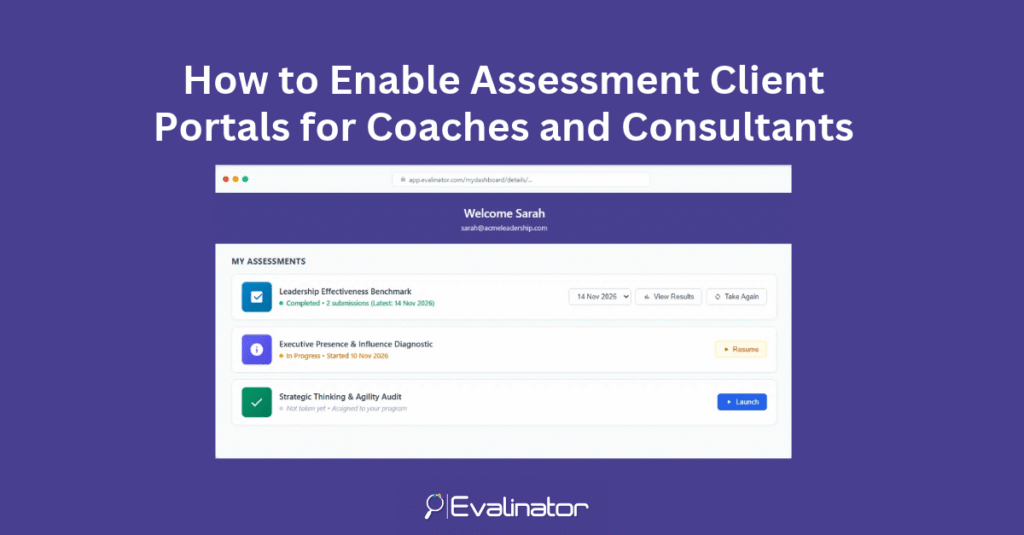
[Image: Client Portal Dashboard showcasing past assessments and goal roadmap]
While ScoreApp is designed strictly for individual self-assessments, Evalinator supports full 360-degree feedback assessments. This allows coaches and executive consultants to collect evaluations from peers, direct reports, and managers, compiling the feedback into comprehensive multi-rater diagnostic reports.
On standard quiz platforms, once a prospect receives their score, the interaction concludes. Evalinator allows coaches and consultants to turn diagnostic insights into action by enabling respondents to set SMART goals directly on their results page. This creates immediate buy-in and provides a concrete agenda for discovery calls or initial coaching sessions.
For ongoing client engagements, Evalinator allows practitioners to re-assess clients at regular intervals (e.g., 30 days, 90 days, or post-program). The system generates comparative before-and-after benchmarks that visually prove client progress and ROI.
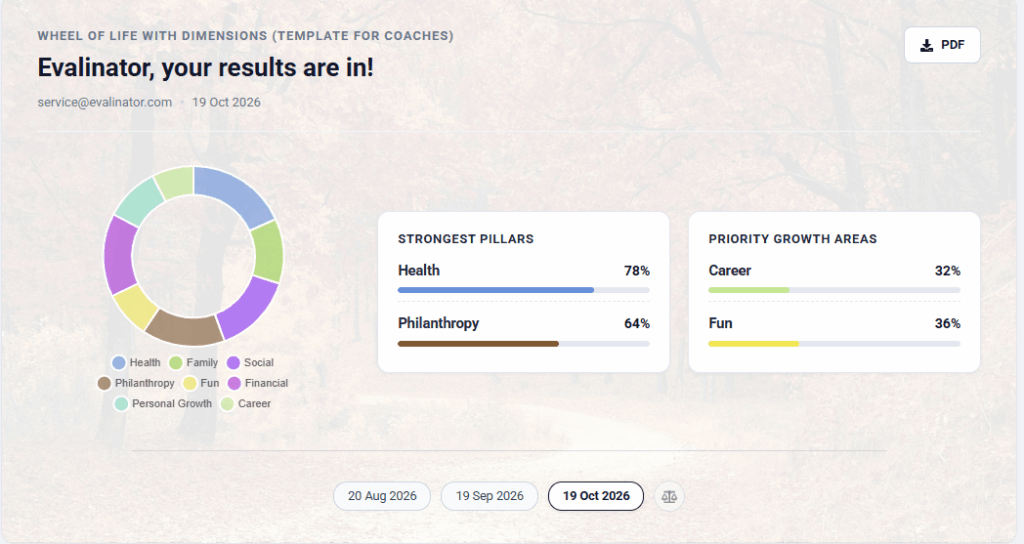
[Results Page Executive Summary featuring multi-dimensional scorecards & visual recommendations]
ScoreApp was co-founded by entrepreneur and author Daniel Priestley, author of Scorecard Marketing and Key Person of Influence. As a result of that marketing effort, ScoreApp has built a strong community, active training workshops, and a library of resources dedicated to top-of-funnel list building.
Both platforms offer 14-day free trials so you can test their builders before committing.
Choosing between ScoreApp and Evalinator depends on your primary business objective and delivery model:
Choose ScoreApp if:
Choose Evalinator if:
Ready to test interactive assessments for your coaching or consulting practice? Start your 14-day free trial of Evalinator today.
Feeling frustrated with lead generation?
Take this free, 5-minute quiz and get more prospects into your leads funnel.
Instant Results. Actionable recommendations. Email required.
Find Your Score >>